Sacramento VIN Verification: Your 2026 REG 31 Playbook
By Get Vin Verification — DMV-licensed vehicle verifier · August 4, 2026
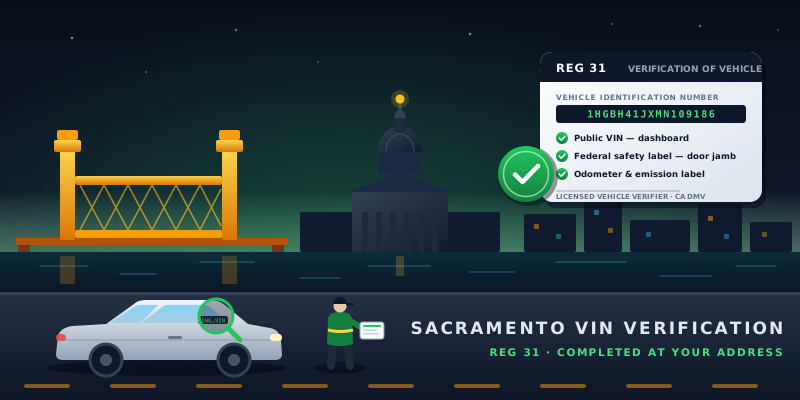
Somewhere in Sacramento right now there's a pickup with Texas plates in a driveway off Freeport, a wagon from Colorado in an apartment lot in Natomas, and a work van from Nevada parked behind a shop on Folsom Boulevard. All three owners are closer to California plates than they think — and all three are waiting on the same single page of paper.
It's called the REG 31, Verification of Vehicle. It takes about ten minutes to complete, and it's the step that turns a stack of out-of-state paperwork into a California registration. What follows is the Sacramento version: what actually triggers the requirement, who is legally allowed to sign one, the deadlines that apply to your situation, and where the county's four DMV field offices are if you'd rather handle it yourself. Everything here is sourced from the DMV's own Vehicle Industry Registration Procedures Manual and the Vehicle Code — not from a forum thread.
First question: does the DMV even require one?
Not every vehicle needs one, and it's worth ninety seconds to check before you book anything. The DMV publishes an explicit list of when a verification of vehicle is always required — and the short list of cases where it isn't.
| Verification required | Verification not required |
|---|---|
| Registering a vehicle last registered out of state — the big one, and the reason most Sacramento appointments get booked. | A new out-of-state trailer eligible for PTI — provided it has never been registered, was not modified, altered, or assembled from a kit, and comes with a secure MCO/MSO for the complete trailer. |
| A vehicle DMV has no record of — except a new vehicle a licensed California dealer reported on a REG 397. | A new commercial vehicle purchased out of state (complete, or an incomplete chassis finished with a new body) — if it has never been registered or issued IRP registration in California (or was issued California IRP registration within the last 60 days only), was not modified, altered, or assembled from a kit, has an unladen weight of 6,001 lbs or more, and meets California emission standards. |
| Recording an engine change, a motorcycle engine case change, or a change from engine number to VIN. | Note: if the vehicle does not meet California emission standards, the verification is required — the exemption falls away. |
| A VIN mismatch — the number on your certificates differs from the number on the DMV record. | |
| Specially constructed (SPCNS) vehicles and trailers, DMV-assigned VIN plates, and re-registering a previous junk or salvage vehicle without a CHP 97C. |
Source: California DMV, Vehicle Industry Registration Procedures Manual §1.165.
If you bought a trailer new and it qualifies for the Permanent Trailer Identification program, you may genuinely be able to skip this step — we broke that down separately in California PTI: Which Trailers Qualify and When You Can Skip the REG 31.
What the inspector is actually doing
A REG 31 isn't paperwork someone fills out from your title. It's a physical inspection, and the form has to be completed from what the inspector can see on the vehicle itself. Every numbered section on the form — all nine of them — needs at least one box checked.
The core of it is confirming your public VIN — on most passenger cars the plate visible through the windshield on the driver's side, though the form has boxes for a door post, the firewall, the steering column and several other locations — and then corroborating it against a second source. On a 1970-or-newer vehicle that second source is one specific sticker, and the rules around it are where driveway visits go wrong.
The two labels — and the model years that decide everything
The inspector checks two different labels, each with its own year cutoff. They are not interchangeable, and failing them has completely different consequences.
| Label | Required on | If it's missing or unreadable |
|---|---|---|
| U.S. Federal Certification Label the VIN's second source | 1970 and newer model years (off-highway vehicles excepted) | Stop — refer to CHP. Not a DMV field office. A licensed verifier cannot complete the form. |
| Emission control label under the hood | 1968 and newer — all vehicles 1978 and newer — motorcycles 1979 and newer — heavy-duty 2003 and newer — OHVs | Verification continues. The verifier checks "None" or "See REMARKS" and explains. |
Thresholds as printed on the REG 31 (REV. 5/2025), sections 6 and 9. DMV publishes two different heavy-duty emission cutoffs — the current form says 1979, while notice VIN 2018-11 says 1980 for heavy-duty OEM diesel. If you're near that line, ask before you book.
The U.S. Federal Certification Label — the DMV manual still calls it the "federal safety label" — is the sticker on the driver's door post or rear door post. It does two jobs: it is the secondary verification of your public VIN, and it certifies the vehicle complies with U.S. Federal Motor Vehicle Safety Standards. It is never used as the primary source of the VIN.
If your vehicle is a 1970 or newer model year and that label is missing, illegible, damaged, altered, or disagrees with your VIN, the verification stops — and it does not go to a DMV field office. Only the California Highway Patrol may search for an alternate VIN and complete the REG 31 in that situation.
This is the detail most Sacramento guides get wrong, and the DMV is partly why: VIRPM §1.165 still prints the pre-2017 line that an alternate VIN "must be located by a DMV employee." That instruction was superseded in March 2017 by DMV notice VIN 2017-08, and the form the verifier actually signs settles it — every one of those boxes carries an asterisk, and the legend reads "DO NOT PROCESS — REFER TO CHP." Drive to Broadway with a missing door label and you will be sent to CHP anyway.
If your vehicle is a 1969 or older model year, none of that applies to you. The federal label was never required on it, so there is nothing to be missing. The REG 31 has a dedicated "Pre-1970" checkbox, it is one of the few boxes in that section with no asterisk, and a licensed verifier completes the form in your driveway like any other vehicle. Off-highway vehicles get a similar pass — they may not carry a federal label and can still be processed, provided the VIN has not been altered.
Worth knowing why a door label goes missing: the most ordinary explanation is a replaced driver's door after a collision. The REG 31 has a "Door Replaced" checkbox sitting right next to the CHP referral legend. If your door has ever been replaced, check for the label before you book a mobile visit.
A few more details from the same manual that catch people out:
- Emission label verification for out-of-state vehicles may be completed by an authorized vehicle verifier or a peace officer, so it is handled in the same visit.
- Parts aren't vehicles. Verifications of incomplete or unassembled vehicles are not acceptable.
- On an electric motorcycle, the serial number on the electric motor is used as the engine number.
- Not every field applies to every vehicle. Axles are recorded only for commercial vehicles and trailers other than camp trailers and trailer coaches. Estimated weight only for trailers other than camp trailers and trailer coaches. Length and width only for camp trailers, trailer coaches, and motorhomes.
Never located your VIN before? Here's where it lives on every vehicle so you know what the inspector will be reaching for.
Who can legally sign your REG 31
This is the part most Sacramento guides get vague about, so here it is exactly as the DMV states it. There are four categories of authorized vehicle verifier — and one of them has a boundary you need to know about.
| Who | Where it happens | Cost | Limits |
|---|---|---|---|
| DMV employee | At a field office | Free | You bring the vehicle to them, during business hours — DMV recommends booking an appointment. The one job only they can do: verifying a vehicle currently registered as an OHV, or titled “C2”, for on-highway motorcycle registration. |
| Peace officer (including military police, Penal Code §830) | Varies | Varies | Also the route for CHP salvage inspections. |
| Auto club employee who provides registration services | At a club branch | Membership-based | Must include the club's abbreviation with their signature. |
| Licensed vehicle verifier (DMV-licensed, CVC §§675.5, 675.6, 11300) | Your address | Fee for the visit | Cannot verify revived salvage, revived junk, SPCNS vehicles, or motorcycles with an unavailable California record (last registered here, but the record has since dropped off the DMV database). Also cannot finish a 1970-or-newer vehicle whose federal certification label is missing, illegible, altered, or disagrees with the VIN — that one goes to CHP. |
The verification is always completed on the Verification of Vehicle (REG 31) unless a REG 124 assigned-VIN application is required instead.
We're the fourth row. Get Vin Verification™ is a DMV-licensed vehicle verifier, which means the trade-off is honest and worth stating plainly: the DMV will do this for free if you drive to them and wait. What we sell is the visit — the inspection happens where the vehicle already is, at a time that isn't a weekday morning at Broadway.
Straight answer on the boundary: if your vehicle is a revived salvage or revived junk, a licensed verifier legally cannot inspect it — that has to be an authorized DMV employee or the California Highway Patrol. The CHP runs the Salvage Vehicle Inspection Program, and a passing inspection produces a CHP 97C Certificate of Inspection. Bring that to the DMV and the verification requirement is satisfied. Anyone in Sacramento advertising mobile "rebuilt title" verifications is selling something they can't deliver.
The three clocks — and which one is actually running
Almost every "you have 20 days" article about California registration is describing one rule and applying it to everybody. There are really three separate deadlines, triggered by three different events, and mixing them up is how people end up paying penalties they didn't need to pay.
Three clocks, three different start buttons
CVC §5900CVC §5902CVC §4152.5Just moved here with a car you already owned? Yours is a different rule — CVC §6700 gives you 20 days from establishing residency or accepting California employment, whichever comes first.
The practical takeaway is the one the DMV itself gives: file the application and pay the fees inside the window even if you're still waiting on the smog certificate or the verification. That's how you avoid penalties while the rest of the package catches up. We went deep on all of this in the complete out-of-state buyer's guide.
Sacramento County has exactly four DMV field offices
If free-and-drive-there is the right call for you, these are your options. Sacramento County has four — fewer than most people assume for a county of roughly 1.6 million people, which is a fair part of why the lines look the way they do.
DMV field offices in Sacramento County
There is no DMV field office in Elk Grove, Rancho Cordova, Citrus Heights, or Galt. Elk Grove's nearest is Sacramento South; Rancho Cordova's is Folsom. Heading north, the closest offices are in Placer County — Roseville (7200 Galilee Rd) and Rocklin (5245 South Grove). From Galt you are actually closest to Lodi (1222 Pixley Pkwy) in San Joaquin County, about half the drive to Sacramento South. Confirm hours and book an appointment at dmv.ca.gov before you drive.
That geography is the whole reason mobile VIN verification exists here. A verification in Elk Grove, Citrus Heights, or Rancho Cordova means a round trip to another city for a ten-minute inspection. Our standard Sacramento County visit is $85 for one vehicle — a $50 travel fee plus $35 per vehicle, so a second vehicle at the same address is $120 total and a third is $155. Placer and Yolo County cities are quoted separately. The service area page lists every city we cover and what each one runs.
What Sacramento registration actually costs you
The verification is one line item. The one that surprises people is use tax, which California charges on just about any vehicle you didn't buy from a California dealer — out-of-state purchases and private-party sales alike — at the rate for the address where the vehicle will live. In this region that rate swings by a full 1.5 points across the cities below, depending on which side of a city limit you land on.
Combined sales & use tax rate by city — effective July 1, 2026
| City or area | Rate | County |
|---|---|---|
| Galt | 9.250% | Sacramento |
| West Sacramento | 9.250% | Yolo |
| Sacramento | 8.750% | Sacramento |
| Elk Grove | 8.750% | Sacramento |
| Rancho Cordova | 8.750% | Sacramento |
| Isleton | 8.750% | Sacramento |
| Citrus Heights | 7.750% | Sacramento |
| Folsom | 7.750% | Sacramento |
| Roseville | 7.750% | Placer |
| Unincorporated Sacramento County | 7.750% | Sacramento |
Source: CDTFA California City & County Sales & Use Tax Rates, effective July 1, 2026. ZIP codes cross city lines, so look up your exact street address at maps.cdtfa.ca.gov rather than trusting a ZIP-level rate. Rates change; confirm yours before you budget.
On a $30,000 truck that's the difference between roughly $2,325 in Folsom and $2,775 in Galt. Worth knowing before the DMV tells you.
Two things that can shrink that number, and both get missed. If you already paid sales or use tax to the state you bought in, you get credit for it — bring DMV the purchase agreement showing the amount and you pay only the difference. And buying from a parent, grandparent, grandchild, child, spouse, or domestic partner is exempt from use tax entirely. Note also that the figures above are calculated on the full purchase price, which the state defines to include trade-in value and any debt you assume — not just the cash that changed hands.
Two more line items to plan for while you're at it. Smog: most out-of-state vehicles need a certification at first registration — gasoline 1976 and newer, diesel 1998 and newer under 14,001 lbs GVWR — while motorcycles and trailers are exempt. The eight-model-year exemption Californians lean on at renewal does not carry over to a nonresident vehicle's first registration. Don't get it done too early, either: a smog certificate is only good for 90 days. Insurance: California's minimums rose on January 1, 2025 to 30/60/15 — $30,000 per person, $60,000 per incident, $15,000 property damage. Plenty of out-of-state policies sit below that, though not all; Texas minimums, for instance, already clear it.
Ten minutes of prep that saves the visit
Whether a verifier is coming to you or you're driving to Broadway, this is the difference between a smooth inspection and a wasted trip. Tap each one as you go.
Sacramento VIN verification FAQ
How much does a VIN verification cost in Sacramento?
A DMV field office performs the verification at no charge — you provide the drive and the wait. A licensed mobile verifier charges for coming to you. Our standard Sacramento County rate is $85 for one vehicle, which is a $50 travel fee plus $35 per vehicle; a second vehicle at the same address brings the visit to $120.
How long does the inspection take?
The physical inspection is usually about ten minutes for a standard passenger vehicle. Nearly all of the elapsed time in a VIN verification is travel and waiting, which is exactly what mobile service removes.
What happens if the federal certification label on my door post is missing?
It depends entirely on your model year. On a 1970-or-newer vehicle, the U.S. Federal Certification Label is the only acceptable second source for your public VIN, and if it is missing, illegible or damaged, only the California Highway Patrol may search for an alternate VIN and complete the REG 31. A licensed verifier cannot finish the job, and neither can a DMV field office. On a 1969-or-older vehicle the label was never required, so the verifier checks the form's "Pre-1970" box and completes the inspection in your driveway as normal.
Can a mobile verifier inspect a revived salvage or rebuilt vehicle?
No. Licensed vehicle verifiers cannot perform VIN inspections for revived salvage, revived junk, specially constructed (SPCNS) vehicles, or motorcycles with an unavailable California record. Those inspections must be done by an authorized DMV employee or the California Highway Patrol. A passing CHP salvage inspection produces a CHP 97C Certificate of Inspection.
Do I need a smog check as well as a VIN verification?
Usually yes. Most out-of-state vehicles need a smog certification as part of the first California registration, and the exemption for newer vehicles that applies at renewal does not apply to a nonresident vehicle. The DMV's advice is to submit your application and fees within your deadline even if the smog certificate is not ready yet, which protects you from penalties while the paperwork catches up.
How many DMV field offices are there in Sacramento County?
Four: Sacramento at 4700 Broadway, Sacramento South at 7775 La Mancha Way, Carmichael at 5209 North Ave, and Folsom at 323 E Bidwell St. There is no field office in Elk Grove, Rancho Cordova, Citrus Heights, or Galt. The county also contains DMV headquarters at 2415 1st Ave and the Sacramento-Florin Industry Business Center, but neither is a walk-in field office for ordinary registration business.
Let's get it verified
A VIN verification is a small step that unlocks a big one. Figure out whether you need one, get the vehicle and documents ready, and get the REG 31 signed by someone actually authorized to sign it — then file inside your window and go enjoy the fact that you live somewhere with a river, a delta breeze, and no snow to shovel.
If the free-and-drive-there route works for your schedule, take it; that's a legitimate option and we'll tell anyone who asks. If it doesn't, that's what mobile VIN verification is for — we come to Sacramento, Carmichael, Folsom, Elk Grove, Rancho Cordova, Citrus Heights, Roseville, and the rest of the region, and complete the REG 31 where your vehicle already sits. Book a verification and let's get you on California plates.
Rules, rates, and fees change. For the current authoritative details, always confirm with dmv.ca.gov.