Buying a Vehicle Out of State as a California Resident or Business: The Complete Buyer's Guide
By Get Vin Verification — DMV-licensed vehicle verifier · June 1, 2026
You found it — the right truck in Phoenix, the clean low-mileage sedan in Dallas, the cargo van that finally fits the business, sitting on a lot in Reno. The price is better than anything in the Sacramento market, the seller will ship it, and you're ready to wire the money. Stop for ten minutes. A handful of checks now decides whether your new vehicle glides through California registration or gets stuck in your driveway, unregisterable.
Buying out of state is one of the smartest moves a California resident or business owner can make. It's also where the most expensive surprises hide. This is the full playbook — and every requirement below is drawn straight from dmv.ca.gov, not a forum thread.
First, the clock: the day it arrives, not the day you get around to it
There's one deadline that actually governs your out-of-state purchase — and a few myths cluster around it. If you're already a California resident or business buying a vehicle from out of state, here's what's really on your calendar:
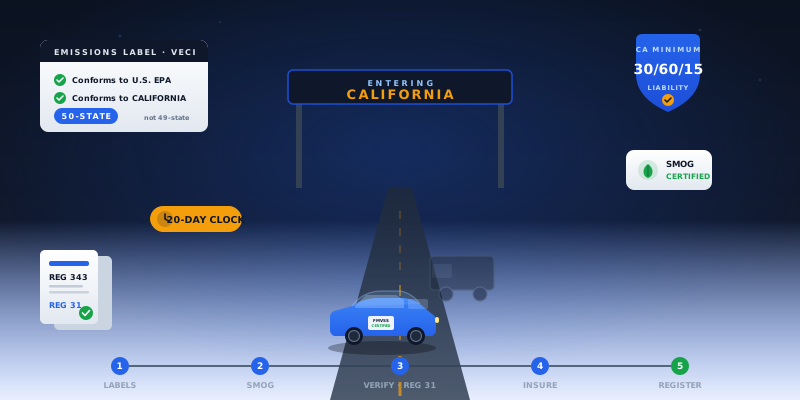
For a vehicle last registered out of state — or brand-new on a Manufacturer's Certificate of Origin (MCO) — California folds your title and registration into one application (the REG 343, "Application for Title or Registration"), and you have 20 days to file it and pay your registration fees without penalty. The clock runs from the day the vehicle enters California — or, if you choose to start your registration before it arrives, from the day you complete the application, whichever comes first. (Vehicle Code §§ 4152.5 / 9552; the trigger dates are set in the DMV's registration manual.)
What about the "10-day" rule you may have read about? That's California's general ownership-transfer deadline (Vehicle Code §5902) — it's for handing a California title to a new owner. An out-of-state car (or a brand-new MCO vehicle) is a single original application on the 20-day clock, so there's no separate 10-day step to scramble for.
Buying from an out-of-state dealer doesn't buy you extra time. The "30-day" grace you may have heard about only applies to California-licensed dealers who file the paperwork for you — an out-of-state lot can't, so you're treated the same as any private-party purchase and your clock still starts the day the vehicle enters California. (Rare exception: a few border dealers also hold a California license and can file it for you.)
The part almost everyone gets wrong: the well-known "20 days after you become a resident or get a job in California" line is a different rule (Vehicle Code §6700), and it's aimed at people moving to California with a car they already own. If you already live or operate here and you're buying out of state, your registration clock runs from the day the vehicle enters the state — no residency milestone required.
Just moved to California with your existing vehicle? Then the §6700 rule is yours: you have 20 days from the date you establish residency or accept California employment, whichever comes first, to register it. (DMV: New California Resident)
Driving a car you don't own? One scenario people mix up. If a vehicle stays registered to a nonresident — an out-of-state employer's company car, or a relative's car you drive daily — you, the driver, must register it within 20 days of first driving it in California (Vehicle Code §6700(c)). It's the same 20 days, just measured from first use instead of date of entry — and it only applies while someone else owns the car. The moment you buy and own the vehicle, that rule drops away and you're on the date-of-entry clock above.
Either way, the homework starts before you buy. And one DMV tip worth its weight in gold: submit your application and fees within the window even if you're still waiting on the smog certificate — that's how you avoid penalties while the paperwork catches up. (DMV: Register a Vehicle From Out of State)
The single most expensive mistake: emissions
California doesn't rely on the federal EPA's standards alone — it runs its own, stricter program through the California Air Resources Board (CARB), and the DMV is blunt about it: all vehicles registered in California must meet California emission controls, and the DMV cannot register a vehicle that doesn't qualify.
Here's the distinction that trips up out-of-state buyers. Every car carries an emissions label stating which standards it meets:
- A 50-state vehicle is certified to both U.S. EPA and California (CARB) standards. This is what you want.
- A 49-state vehicle — the DMV's official term is a California Noncertified Vehicle (CNCV) — bears a label certifying it meets only U.S. EPA requirements, not California's.
And this is the rule that costs people thousands: a CNCV (49-state) vehicle cannot be registered to a California resident who acquired it with fewer than 7,500 odometer miles, unless they qualify for a specific exemption. Once the vehicle crosses 7,500 miles, it's generally registrable regardless of the 49-state label. (DMV: Noncertified/Direct Import Exemptions)
The trap, in one line: a nearly-new vehicle with a 49-state-only emissions label and under 7,500 miles is the one California will turn away at the counter.
Worse, a refusal isn't always temporary. When the DMV declines a noncertified vehicle, it can place a VLT Stop (Reason Code 89) on the record — and as a rule that flag can't be removed. Treat it as a permanent bar: this is not a "drive it around to rack up miles" situation. Check before you buy.
We wrote a deeper breakdown of just the emissions-label decision in Check the Emissions Label Before You Sign — read it if you're buying anything new or low-mileage.
Two labels to photograph before you pay
Ask the seller for clear photos of two specific labels. They live in different places and prove different things — and a missing or altered label is exactly what complicates your REG 31 and stalls registration later.
1. The Vehicle Emission Control Information (VECI) label — usually under the hood. This is the one that tells you 50-state vs. 49-state. If it lists California, you're in great shape.
2. The Federal Certification Label (FMVSS) — on the driver's-side door jamb. It carries the VIN, build date, and gross weight ratings, and certifies the vehicle was built to U.S. Federal Motor Vehicle Safety Standards. If it's missing, painted over, or doesn't match the paperwork, that's a red flag — and it makes the VIN verification harder.
And while you're asking — get the VIN itself, too. Request a photo of the dashboard VIN (driver's side, visible through the windshield). It costs the seller nothing, and it's the fastest way to catch a problem early: you can confirm that public VIN matches your title and the Federal Certification (door-jamb) label — the two places the VIN should appear — before you wire a dollar. (The emissions label proves the standards, not the vehicle's identity, and often doesn't carry the VIN at all.) (Not sure what you're looking at? Here's where the VIN lives on every vehicle.) Then run it through our free VIN decoder to confirm the factory specs match the listing — that page also links to a recall check, the free NICB stolen-vehicle lookup, and vehicle-history resources worth using before any out-of-state buy.
Pro tip: A reputable seller will text you photos of both labels, the dashboard VIN, and the odometer without hesitation. If they dodge the request, walk away. That five-minute exchange is the cheapest insurance you'll ever buy.
Smog: yes, even on a newer car
People assume a recent-model car skips smog. For out-of-state vehicles, that assumption is wrong. The DMV's basic registration requirements state plainly that the smog exemption for newer vehicles does not apply to nonresident (out-of-state) vehicles. A smog certification is part of registering most out-of-state cars and trucks. (DMV: Basic Registration Requirements)
A few categories are generally exempt — the oldest gasoline vehicles and fully electric cars among them — but confirm yours on the DMV's smog page rather than guessing. You can get the test at any BAR-licensed / STAR station once the vehicle is here.
Insurance: California raised the minimums in 2025
This one is brand new, and a lot of out-of-state policies don't meet it. Effective January 1, 2025, California's minimum liability limits increased for the first time since 1967. Raised by 2022's SB 1107 (the new limits are set in California Vehicle Code §16056), the minimums are now:
- $30,000 for injury or death to one person
- $60,000 for injury or death to more than one person
- $15,000 for property damage
That's 30/60/15, up from the old 15/30/5. (DMV: Insurance Requirements) Proof of insurance is required to register — without it, the DMV suspends the registration. If you're registering commercial or fleet vehicles for a business, additional coverage may be required, so check with your carrier before the vehicles arrive.
The paperwork the DMV actually wants
Here's what you'll hand over to register an out-of-state vehicle in California:
- Application for Title or Registration (REG 343)
- The out-of-state title — or a Manufacturer's Certificate of Origin (MCO/MSO) for a vehicle that was never registered
- The last out-of-state registration (or a renewal notice)
- A completed Verification of Vehicle (REG 31) — the VIN inspection (more on this next)
- An odometer disclosure
- A smog certification, if applicable
- For commercial vehicles: weight documentation (a weighmaster's certificate or a REG 4008 gross-weight declaration, depending on the vehicle); a REG 256F if you're claiming an emissions exemption
One useful exception for businesses: a REG 31 may not be required for a new commercial vehicle or new trailer purchased in another state. For any other out-of-state vehicle you're registering, the REG 31 is required. (DMV: Basic Registration Requirements)
Where the mobile VIN verification fits
That REG 31 — the "Verification of Vehicle" — is a physical inspection. Someone has to lay eyes on the VIN, confirm it matches your ownership documents, and sign the official form the DMV requires for an out-of-state registration.
You have two ways to get it done. The DMV will verify a VIN for free at a field office — it's a legitimate option (usually a separate verification line), and if the cheapest path is all you're after, take it. The trade-off is the drive, the wait, and the parking. The other way is a mobile VIN verification: a licensed vehicle verifier comes to you — your driveway in Folsom, your apartment lot in Citrus Heights, your business yard in Rancho Cordova or West Sacramento — and completes the REG 31 in about ten minutes, no DMV line and no hauling the vehicle anywhere. Free is free; convenient and professional is what a mobile verifier is for.
There's also a quieter payoff to having a licensed pro look first. Get Vin Verification™ regularly catches problems before a customer wastes a DMV trip on them — a 49-state emissions label on an under-7,500-mile car, a VIN that doesn't match the door label or the title, a missing certification sticker. Spotting that in your driveway means you can go back to the seller or dealer for the remedy before you're standing at a counter getting turned away. That's the difference between a vehicle you can actually register and drive, and one stuck in limbo.
For businesses bringing in several vehicles at once, a mobile verifier can knock out the whole batch on-site in a single visit — across Roseville, Elk Grove, Vacaville, Lincoln, and the rest of the Greater Sacramento area.
Your pre-purchase checklist
Before you send a dollar to that out-of-state seller, run this:
- Confirm the emissions label says California (50-state) — or that the vehicle has 7,500+ miles if it's 49-state only
- Get photos of the VECI label, the Federal Certification (FMVSS) label, the dashboard VIN, and the odometer — then decode the VIN to confirm the specs match
- Verify the title is clean and that the name and the VIN match the seller's paperwork
- Line up the full path: smog certification, 30/60/15 insurance, and your REG 31 VIN verification (free at a DMV field office, or come-to-you with a mobile verifier)
- Don't wire money until items 1–3 check out
Get it verified, get it registered
Buying out of state can absolutely be the right call — you just want to be the buyer who did the ten minutes of homework, not the one with an unregisterable car in the driveway. Confirm the labels, line up your smog and insurance, and gather the paperwork.
Then, once the vehicle lands in your driveway or yard, get your REG 31 done — free at a DMV field office, or come-to-you with a mobile VIN verification — and file your registration well inside the 20-day window. Let's get it verified.
Requirements and fees can change. For the current, authoritative details, always confirm with dmv.ca.gov.