California PTI: Which Trailers Qualify and When You Can Skip the REG 31
By Get Vin Verification — DMV-licensed vehicle verifier · May 2, 2026
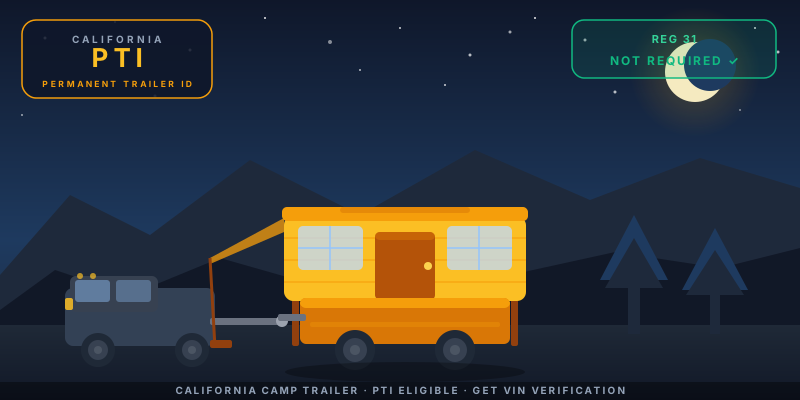
You just hauled a brand new pop-up camp trailer home from a dealer in Nevada. MCO in hand, plates nowhere, and three different people have told you to "just get a VIN verification" before heading to the DMV.
Here's what none of them mentioned: you might not need one.
That's California's Permanent Trailer Identification program. And most trailer buyers — including a lot of dealers — never bring it up.
What Is PTI?
PTI stands for Permanent Trailer Identification. It's California's registration program for qualifying trailers that swaps the annual registration cycle for a one-time registration and a permanent plate. Register it once, get a plate, and you're done. No annual sticker. No renewal postcard. No "oops I forgot."
For qualifying trailers that are brand new and arrive from another state with a secured MCO/MSO, the REG 31 vehicle verification is waived entirely. No verifier, no DMV inspection appointment, no towing it somewhere to be looked at.
The full breakdown of when that exception applies is on our vehicle verification exceptions page. Three conditions must all be true: never registered anywhere, not modified or altered, and secured MCO/MSO submitted for the complete trailer. Hit all three — you're past the verification step.
Which Trailers Are PTI Eligible?
The DMV's PTI definitions cover a range of trailer types. Here's where to find yourself — and where most people find out they didn't need to call anyone.
Camp Trailers — The One Most Buyers Miss
Under California law (CVC §242), a camp trailer is any trailer capable of human habitation for camping or recreational purposes that does not exceed 16 feet in overall length (from hitch to rear) and 96 inches in width. Where the trailer telescopes for travel, that measurement applies to the trailer fully extended.
The DMV's own definition makes one thing explicit: a tent trailer is a camp trailer. But the definition is broader than that. It's not about the style of construction — it's about the dimensions and the purpose. Any towed trailer that sleeps people and stays within 16 × 8 feet qualifies:
- Pop-up / folding / tent trailers — the expandable canvas kind
- Teardrop trailers — small hard-shell sleepers
- A-frame campers — the collapsible triangular type
- Small fiberglass campers — compact egg-shaped or hard-shell units within the size limits
- Hybrid trailers — hard-sided body with fold-out tent ends
- Small fixed travel trailers — any hard-shell under 16 feet with sleeping accommodations
PTI eligible. And if the unit is brand new, coming from an out-of-state dealer with the MCO in hand and zero prior registration history, the REG 31 is waived.
Most of these owners don't find this out until after they've already scheduled a verifier. Or worse, towed their trailer to a DMV office for a step the law didn't require.
The 16-foot line is everything. A pop-up at 12 feet is a camp trailer. A travel trailer at 24 feet is a trailer coach — an entirely different registration category that cannot use PTI and is not exempt from the REG 31.
Utility Trailers
Under CVC §667, a utility trailer is a trailer or semitrailer used solely for the transportation of the user's personal property, not in commerce — or designed and used for transportation of livestock — with a gross weight or GVWR of 10,000 lbs or less.
Flatbeds, cargo trailers, landscape trailers, equipment trailers — if you're pulling your new trailer home from an out-of-state dealer with an MCO and no prior registration, same rule applies: three conditions met, no REG 31.
Horse Trailers and Livestock Trailers
Horse trailers and stock trailers fall squarely under the utility trailer definition — they're designed and used for transportation of livestock. The DMV's own rules clarify that living quarters in a livestock trailer don't change its classification: those are secondary and incidental to the primary purpose, which is hauling animals.
New horse trailer from a dealer in Idaho or Arizona, MCO in hand, never registered — three conditions met, no REG 31 needed. Same as the flatbed next to it on the dealer lot.
One You Probably Didn't See Coming — Tow Dollies
Tow dollies (VC §617) — the two-wheel platforms you mount the front or rear wheels of a towed vehicle onto — aren't required to register at all in California. But they may register under PTI. If you're crossing state lines regularly, the DMV actually recommends it: some other states require indicia (ID markings) on specialized trailers, and having a PTI plate solves that problem cleanly.
The Line That Separates Camp Trailers From Everything Else
16 feet. That's the number burned into CVC §242, and it's the line that separates camp trailers from travel trailers in California's registration system.
A pop-up trailer at 12 feet overall — camp trailer, PTI eligible.
A 24-foot travel trailer with air conditioning and a full kitchen — trailer coach under VC §635, not PTI eligible, gets full annual registration, and is not exempt from the REG 31.
Fifth-wheel travel trailers work the same way: if they exceed the 16-foot / 96-inch camp trailer dimensions, they're trailer coaches. The fifth-wheel connection doesn't change the analysis.
Most tent-style pop-ups are well under 16 feet when measured from hitch to tail. Most full-size travel trailers are well over. If you're not sure which category yours falls in — measure it. The cutoff is exact.
The Three Conditions For Skipping the REG 31
Works the same for every PTI-eligible trailer type above:
1. Never been registered anywhere. No prior plates, no prior title, no temporary registration — from the factory to your hitch with nothing in between.
2. Not modified, altered, or kit-assembled. Off the factory floor and onto your trailer ball without anything changed. A new body added to a new incomplete chassis (multi-stage build) is allowed — aftermarket modifications are not.
3. Secured MCO/MSO submitted. The actual Manufacturer's Certificate or Statement of Origin — properly secured, not a photocopy, not a dealer printout. The real document for the complete trailer (or separate documents for cab/chassis and body for multi-stage units).
All three. Every time.
When You Still Need the Mobile VIN Verification
Used trailer. Even registered once, anywhere, the exception is gone. Modified. Any alteration kills it. No MCO. Without the secured manufacturer's document, you need the REG 31 regardless.
In those cases, mobile VIN verification is the practical answer. We come to wherever the trailer is sitting in Sacramento, Folsom, Elk Grove, Roseville, Carmichael, Rancho Cordova, Lincoln, or anywhere else in the Greater Sacramento area. The inspection takes about ten minutes. You walk away with a completed REG 31 and you're ready for DMV.
Not sure where you fall? Call us before you book anything. Thirty seconds of talking might save you an appointment you didn't need.
Get in touch. We'll tell you straight.
More on trailers: Trailer, RV & OHV VIN verification — the trailer classes that decide PTI eligibility, where trailer VINs live, and what we check on site.