Barn Find Registration: You Probably Don't Owe 30 Years of California Back Fees
By Get Vin Verification — DMV-licensed vehicle verifier · July 26, 2026
There's a truck under a tarp in a barn outside Rio Linda that hasn't moved since the Clinton administration. Your uncle left it to you. You want to drive it.
And the thing stopping you isn't the carburetor. It's the arithmetic you've already done in your head: thirty-one years of California registration, times whatever they charge now, plus penalties on every one of those years. Four figures? Five?
Put the calculator down. There is an actual statute for this, and most people have never heard of it.
The Law Is Real: Vehicle Code §4604.2
This is the part that gets repeated wrong at every swap meet — usually as a vague "they can't charge you back fees on an old car." The real version is narrower, but it's written down, and it's mandatory language:
An application "shall be accepted by the department upon payment of the proper fees for the current registration year without the payment of delinquent fees" — CVC §4604.2(d)
Not may accept. Shall. And "delinquent fees" there covers both the Vehicle Code fees and the vehicle license fee under the Revenue and Taxation Code.
Two kinds of vehicles qualify under §4604.2: partial-year registered vehicles, and — the one you care about — vehicles described in §5004 or §5004.5, submitted with a certificate of nonoperation covering the period the vehicle wasn't registered.
Which Vehicles §5004 Actually Covers
§5004 is California's Horseless Carriage / Historical Vehicle statute. Three categories qualify:
- A motor vehicle with an engine of 16 or more cylinders, manufactured before 1965
- A motor vehicle manufactured in 1922 or earlier
- A vehicle manufactured after 1922 that is at least 25 years old and of historic interest
§5004.5 covers motorcycles manufactured in 1942 or earlier.
That third category is where most barn finds land — but read the definition, because it has teeth. A vehicle is "of historic interest" only if it is "collected, restored, maintained, and operated by a collector or hobbyist principally for purposes of exhibition and historic vehicle club activities." The statute also frames these as vehicles operated "primarily for the purpose of historical exhibition."
A 25-year-old commuter car you plan to drive to work every day is not this. The age alone doesn't do it.
The Timing Trap That Voids Everything
Here's the sentence that costs people the exemption, and nobody warns them:
The fee relief applies only "if the department receives the application and certificate of nonoperation prior to the date the vehicle is first operated, moved, or left standing upon a highway during the current registration year."
Read that again. Before. Not the same week. Not after you get it running.
Drive it to a smog station. Push it into the street to load it on a trailer. Park it at the curb while you clean out the barn. Any one of those can happen before DMV has your paperwork — and the exemption you were counting on is gone.
Do the paperwork while it's still on private property. The barn, the driveway, the yard. The moment that vehicle touches a highway, the clock you needed has already run out.
One more catch from the same article: for this purpose a "vehicle" must have "intact and assembled its major component parts," including the frame or chassis, cowl, and floor pan. A pallet of parts and a promising rumor isn't a vehicle yet.
Not a Historic-Interest Vehicle? You're Still Fine
Say it's a 1994 work truck. Too new for §5004's spirit, no club activities in its future. You're on a different track — and it's still not thirty years of fees.
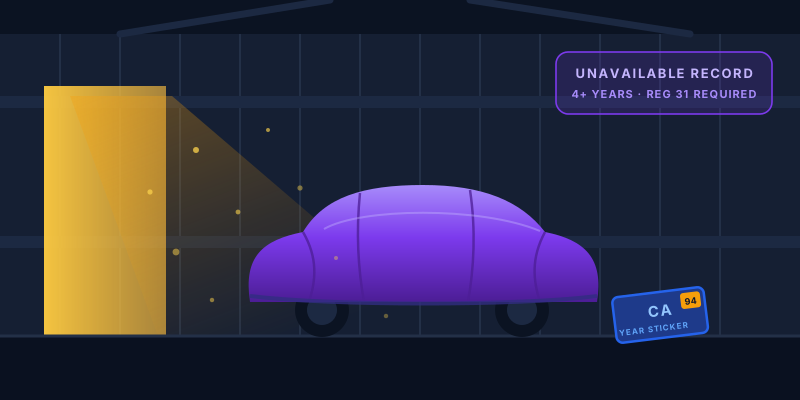
If a California-titled vehicle hasn't been registered for four years or more, it may no longer have a DMV computer record at all. DMV calls this an unavailable record, and the record has to be rebuilt from scratch even if you're holding the original pink slip.
For those, DMV's own instruction is plain: "Fees are due from the date the vehicle is first operated." Not from the year it stopped being registered. The packet includes a REG 102 (Certificate of Non-Operation) or a REG 256 certifying nonoperation.
The honest caveat on both tracks: this works because it genuinely sat. If that truck was quietly driven around unregistered for twenty years, that's a different conversation.
If You Bought It With Fees Already Owed
CVC §9562 covers the buyer who inherited someone else's mess:
- §9562(a) — DMV may waive the penalties when they accrued before you bought it and you weren't aware fees were unpaid, upon payment of the registration fees due.
- §9562(c) — DMV may waive the fees and penalties if the plate still displays a DMV-issued validating device bearing the registration year you're asking them to waive.
- §9562(d) — those unpaid fees are the transferor's personal debt — the seller who didn't pay them — and where DMV waives under (c), it can pursue that person in a civil action.
That §9562(c) detail is worth a flashlight. Go look at the plate before you pull anything off it — a crusty old validation sticker isn't garbage, it's leverage.
Where the REG 31 Comes In
Any of these routes needs a REG 31, the Verification of Vehicle. Which path you're on depends on what's in the glovebox.
You have the old California title or registration card. That's supporting documentation, and a licensed vehicle verifier can complete the REG 31 right there. I come to the barn. Mobile VIN verification means the truck doesn't have to start, doesn't have to be insured, and doesn't have to be towed — which matters when it hasn't turned over since 1994. You skip the DMV entirely for this step.
You have nothing. No title, no registration card, no paperwork. Then DMV goes first: you'll need a Report of Deposit of Fees, and only when it's issued under reason code 5 can a licensed verifier do the verification. Otherwise it goes to DMV or CHP, at the office manager's discretion.
The Ones I Have to Hand Back
Straight, so nobody wastes a trip:
- Used motorcycles with an unavailable California record — DMV or CHP only.
- Revived salvage or revived junk vehicles.
- Motorcycles with engine changes.
- Incomplete or unassembled vehicles.
- 1970 and newer whose Federal Certification Label is missing or illegible — that one gets referred to DMV.
Pre-1970 vehicles never carried that label, so if your barn find is genuinely vintage it usually isn't your problem. The full list is on our prohibited verifications page.
This County Is Full of These Barns
Rio Linda, Galt, Wilton, Orangevale, out past Folsom toward the foothills — the Sacramento area is packed with vehicles that stopped being registered when gas was a dollar a gallon. Most are still sitting there because somebody did the same bad math you did.
Missing the title entirely? Start with registering a vehicle without a title. VIN so old the format looks strange? We do classic vehicle VIN research too.
Otherwise I'll come to Sacramento, Folsom, Elk Grove, Citrus Heights, Roseville, Carmichael, Rancho Cordova, Antelope, or Fair Oaks — wherever the tarp is.
Just don't move it onto the road first. Then pull the tarp off. Let's get it verified.