Registering Your Classic Car in Folsom: The VIN Process
May 19, 2023
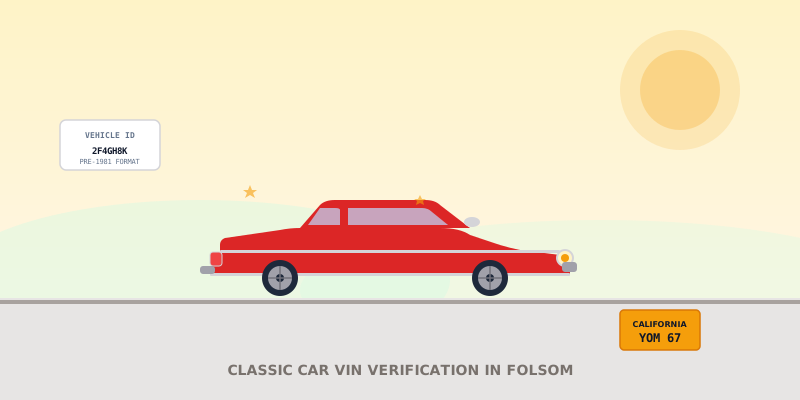
Folsom and classic cars go together like chrome and sunshine. Between the weekend cruisers rolling out to Folsom Lake and the car shows in the Historic District, this town knows how to appreciate a beautiful machine. But if you just hauled a vintage beauty in from out of state, there's one thing standing between you and the open road: a VIN verification.
Don't worry — it's not as scary as it sounds. But classic cars do come with their own quirks.
Pre-1981 VINs: A Whole Different World
Here's something that surprises a lot of people. Modern vehicles all have a standard 17-digit VIN. Clean, consistent, easy to find. But if your classic is from before 1981? All bets are off.
Your VIN might be 5 digits. Maybe 10. Maybe some weird combo with letters that doesn't look like anything you'd find on a modern car. That's totally normal for the era — but it means you need a verifier who actually knows what they're looking at.
Licensed VIN verifiers are specifically trained to recognize and authenticate these older, non-standard formats. They've seen it all — from hand-stamped chassis numbers to riveted body plates that haven't been touched since Eisenhower was president.
Rusted, Painted Over, or Missing Plates
Time is not kind to VIN plates. After 50, 60, 70+ years, it's incredibly common to find plates that are:
- Rusted beyond recognition — California salt air and Sierra winters don't help
- Painted over during a well-intentioned (but misguided) restoration
- Completely missing — fell off, removed, or lost to history
Here's the critical part: do NOT try to scrape, clean, or alter the plate yourself. Seriously. Tampering with a VIN plate — even with good intentions — can create legal headaches that are way worse than a rusted tag.
If the VIN is unreadable, a private verifier will refer you to the CHP for a secondary inspection. It's an extra step, but it's the right way to do it.
Engine Numbers vs. VINs (The Old-School Curveball)
This one is a classic car specialty, pun intended. On a lot of early models — especially pre-1950s Fords and Chevrolets — the engine number doubled as the VIN for registration purposes.
Fast forward 70 years and a couple of engine swaps later... the paperwork says one thing, and the motor under the hood says something completely different. An experienced verifier can spot these discrepancies before you get to the DMV, saving you from a very confusing (and very long) conversation at the counter.
Mobile Verification: Keep Your Garage Queen Safe
Let's be real — if you just spent months (or years) tracking down the perfect '67 Mustang, the last thing you want to do is drive it unregistered down Folsom Blvd to the DMV. And if it's not running yet? That's a tow truck bill you don't need.
A mobile verifier comes straight to your garage. They inspect the VIN, fill out the REG 31, and leave. Your car never has to brave the open road until its paperwork is buttoned up and legal. Peace of mind for you and your prized possession.
Bonus: The YOM License Plate Program
Once your classic car is verified and registered, here's the cherry on top that Folsom car enthusiasts love — California's Year of Manufacture (YOM) license plate program.
This lets you legally display vintage, period-correct California plates on your classic car. Find a pair of black-and-gold 1967 plates at a swap meet? You can actually run them on your '67. It's the perfect finishing touch to any restoration and guaranteed to turn heads at every car show in the Historic District.
Now that's how you register a classic car in Folsom.